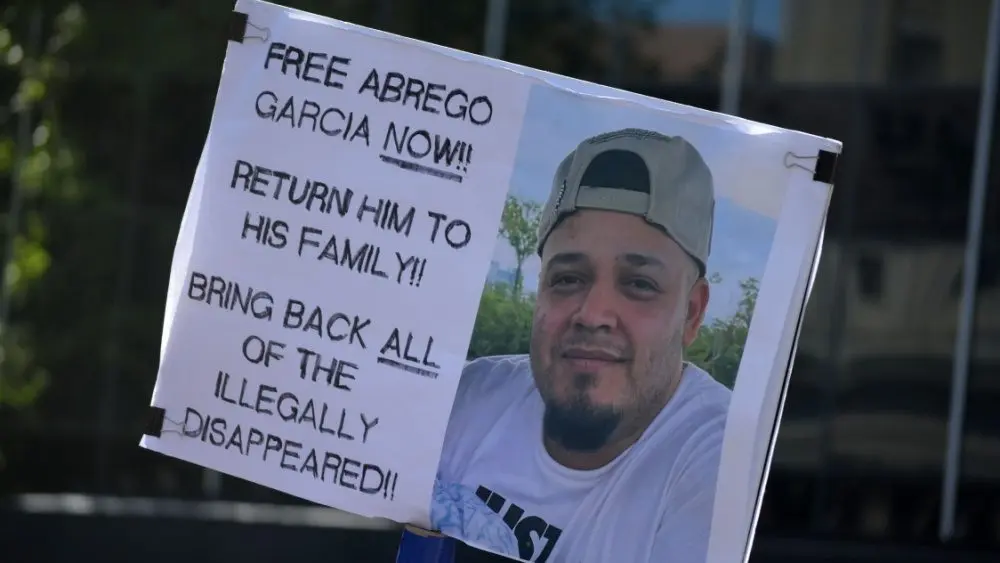
A federal judge has ordered the release of Kilmar Abrego Garcia, a Salvadoran man who was mistakenly deported earlier this year and has since been held in immigration detention, finding that the Trump administration has held him for months without the legal authority required to continue his detention or remove him from the United States.
The ruling, issued Thursday by U.S. District Judge Paula Xinis in Maryland, granted Abrego Garcia’s habeas petition, concluding that federal authorities lacked the legal basis to continue holding him. In her decision, Xinis determined that the government had no valid final order of removal allowing Abrego Garcia’s deportation, despite repeated attempts by the Trump administration to expel him: “Because respondents have no statutory authority to remove Abrego Garcia to a third country absent a removal order, his removal cannot be considered reasonably foreseeable, imminent, or consistent with due process,” Xinis wrote, adding, “Although respondents may eventually get it right, they have not as of today. Thus, Abrego Garcia’s detention for the stated purpose of third country removal cannot continue. Respondents’ conduct over the past months belie that his detention has been for the basic purpose of effectuating removal, lending further support that Abrego Garcia should be held no longer.”
The judge directed federal officials to release Abrego “immediately,” notify him in advance of the precise time and location of that release, and update the court by 5 p.m. Eastern. She also noted that the government’s conduct “belie[s] that his detention has been for the basic purpose of effectuating removal.” DHS spokespersons sharply attacked the decision after Thursday’s ruling, calling it “naked judicial activism by an Obama-appointed judge” and asserting that the order “lacks any valid legal basis.”
Abrego, a Salvadoran national, first entered the U.S. in 2012 and has long maintained that he fled “gang violence targeting his family.” Although an immigration judge granted him “withholding of removal” in 2019—barring his return to El Salvador due to credible threats—he was nevertheless deported in March to the CECOT megaprison after officials later claimed he was linked to MS-13, an accusation he denies and has never been convicted of. Government lawyers later conceded the deportation was an “administrative error,” prompting the Supreme Court in April to require his return.
Following months of resistance, the administration brought Abrego back in June, immediately charging him with human smuggling based on a 2022 traffic stop. He has pleaded not guilty. After briefly living with family in Maryland under pretrial conditions, he was taken into ICE custody again—despite the absence of a removal order—and held for third-country deportation.
Throughout the case, the administration has explored sending him to a series of countries with which he has no ties, including Uganda, Eswatini, Ghana, and Liberia. Xinis criticized those efforts, noting that officials ignored Costa Rica, which publicly confirmed it would accept Abrego as a refugee. “Respondents’ calculated effort to take Costa Rica ‘off the table’ backfired,” she wrote, citing repeated notifications to him of expulsion to African nations “that never agreed to take him.” The administration has continued to insist that Abrego is a gang member, though judges have questioned the evidence. Senior officials, including President Donald Trump and top homeland security leaders, have vowed that Abrego would “never walk America’s streets again.”
Xinis summarized the situation bluntly: “The history of Abrego Garcia’s case is as well known as it is extraordinary.” Now with the judge’s order in effect, Abrego will resume complying with pretrial conditions in his criminal case under the supervision of U.S. Pretrial Services.
Editorial credit: Christopher Penler / Shutterstock.com